
A structural shift is underway
Internal audit is operating in an environment that has changed materially. Organizations are upgrading core systems. ERP platforms are evolving. Data architectures are shifting. Cloud-based applications are replacing legacy infrastructure. Specialized systems now support discrete components of end-to-end processes. Technology ecosystems are expanding across finance, operations, procurement, HR, logistics, and compliance. At the same time, businesses are scaling in transaction volume, automation depth, geographic complexity, digital integration, and decision velocity.
Overlaying these operational shifts is something equally significant: the audit profession itself is evolving, and executive expectations are rising with it. Professional guidance increasingly reinforces risk-based, forward-looking assurance, ongoing monitoring where feasible, data-enabled scalability, proportional oversight aligned with enterprise complexity, and reliable, defensible evidence.
The old model was rational for its time
For decades, the traditional audit model was proportionate to technological constraint. Sampling was necessary because tools could not process full populations efficiently. System-by-system reviews were practical because cross-system analytics were limited. Data extraction was manual and often expensive. Continuous monitoring was aspirational but operationally unrealistic.
Periodic testing was responsible oversight within the limits of available infrastructure. The legacy model was rational. It was built around constraint. Those constraints no longer define the present environment.
What has changed, and why it matters
Modern enterprises no longer operate within contained systems. A transaction may originate in one platform, route through another, execute in a third, and reconcile in a fourth. Each system may operate correctly in isolation. Risk frequently emerges between them.
- Cross-system visibility gaps
- Seam risk and handoff failure
- Workarounds that persist post go-live
- Evidence drift across platforms
- Unclear ownership and escalation paths
- Segregation of duties conflicts spanning multiple systems
- Vendor master manipulation preceding suspicious payment activity
- Expense reimbursement anomalies visible only when PCard and AP streams are combined
- Revenue inconsistencies tied to operational platforms
- Behavioral patterns that appear only in cross-system aggregation
Auditing within silos while risk lives in system intersections creates blind spots. The feasibility constraint that once justified sampling has materially shifted. ERP-native monitoring modules enable continuous oversight of access conflicts, approval overrides, and control breakdowns. Analytics platforms enable full-population testing at scale. Anomaly detection platforms evaluate entire ledgers. Unified spend monitoring integrates AP, PCard, and reimbursement data to identify leakage, policy violations, and fraud risk.
Indicators of operating model misalignment
In organizations that have not yet evolved their operating model, early signals often appear subtly. Audit reports are technically accurate, yet findings repeat. Remediation plans are documented, yet systemic risk patterns persist. Leadership acknowledges issues, yet little strategic change follows.
Audit teams learn about system implementations and process changes during fieldwork rather than at design. New digital initiatives proceed without early audit inclusion. The function becomes reactive rather than embedded.
What modern audit maturity looks like
In digitally mature organizations, audit owns structured continuous monitoring review. Audit designs and operates population-level analytics, evaluates signals across interconnected systems, and establishes disciplined oversight routines that scale with enterprise complexity.
This is the inflection point between a function that reports after outcomes and a function positioned as a strategic partner. Modern audit does not wait for periodic engagements to discover breakdowns. It maintains ongoing visibility into risk patterns and exception signals, then engages business owners when thresholds are exceeded, risk elevates, or systemic inefficiencies surface.
When monitoring signals surface elevated risk, audit engages business owners strategically, confirms root cause, aligns remediation timelines, and enforces structured follow-up until resolution is complete. Review cadence, escalation pathways, documentation standards, and closure criteria are defined. Closure is tracked and verified, not assumed.
This operating model expands audit’s impact across financial integrity, fraud detection, conflict of interest oversight, leakage prevention, operational efficiency, and Enterprise Risk Management alignment. It increases visibility early enough to influence decisions, not simply document outcomes.
How strong leaders navigate the transition
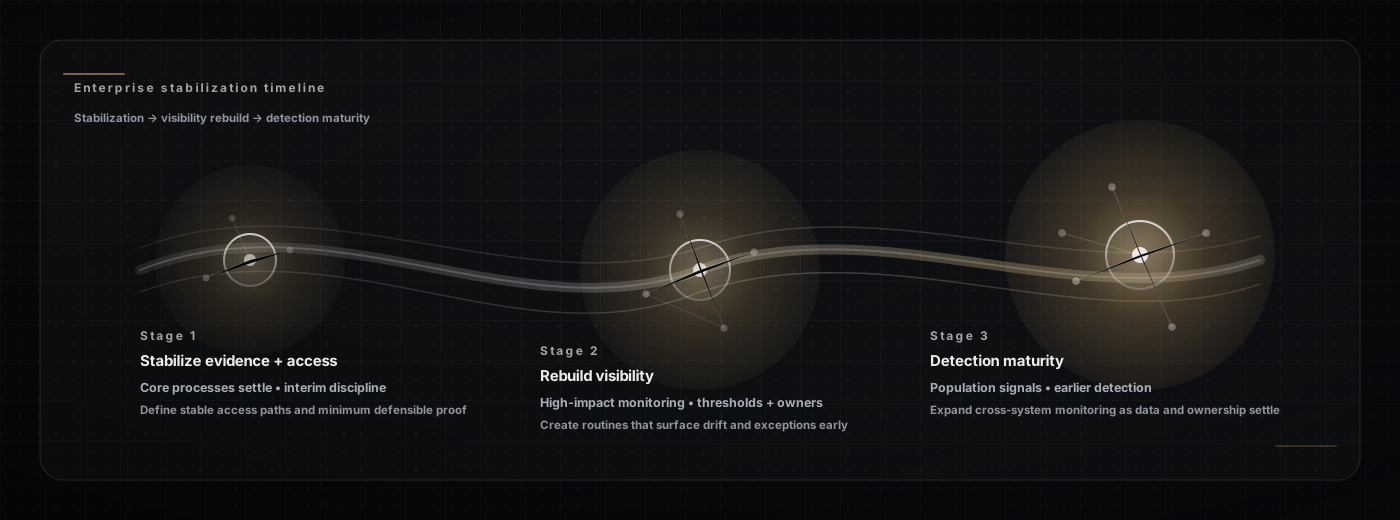
The response to structural evolution is not urgency. It is discipline. Mature programs stage capability intentionally: stabilize defensible evidence and access first, activate embedded monitoring next, expand cross-system visibility after ownership and data settle, and introduce targeted third-party platforms where differentiated value exists.
The order matters. Monitoring layered onto unstable access produces noise and credibility loss. Architecture must stabilize before automation expands.
Architectural leadership defines the future
One path leads toward scalable, forward-looking, strategically embedded oversight. The other preserves periodic testing, siloed reviews, and sampling where full-population testing is feasible. That legacy model can continue operating. Gradually, reports repeat. Inclusion shifts later. Influence narrows. Over time, the function becomes proportionally smaller relative to enterprise complexity. Irrelevance rarely arrives abruptly. It accumulates.
The enterprise has scaled. Standards have advanced. Executive expectations have risen. The operating model must evolve with them.